



Which Asian countries can a European or an American actually move to, and enjoy? It’s the question I get most, from both sides of the Atlantic. Moving there for real, and staying because you love it.
I recently made the same effort for Europe. And as someone whose better half is Chinese, I’ve spent enough time in Asia to have a lot of friends there, and plenty of direct feedback to draw on for this summary.
We also work globally at Bitizenship, with many Asian clients and partners, and I think that for anyone who wants a glimpse of the future, some Asian countries are marvellous.
There’s one difference from Europe, and it shaped how I built this piece. Whoever wants to live in Asia, American or European, is usually already drawn to it, and will surely love some of these countries. What really decides where you thrive is the visa. So I grouped the options by type, so you can quickly see if one fits you.
Unlike the West, Asia runs migration on a logic of “temporary” visas. Some are very difficult to get, like Japan. Some open up with foreign income, like Taiwan. Others want a company there that employs you, like Singapore. And others are more permissive for the short term, like Thailand.
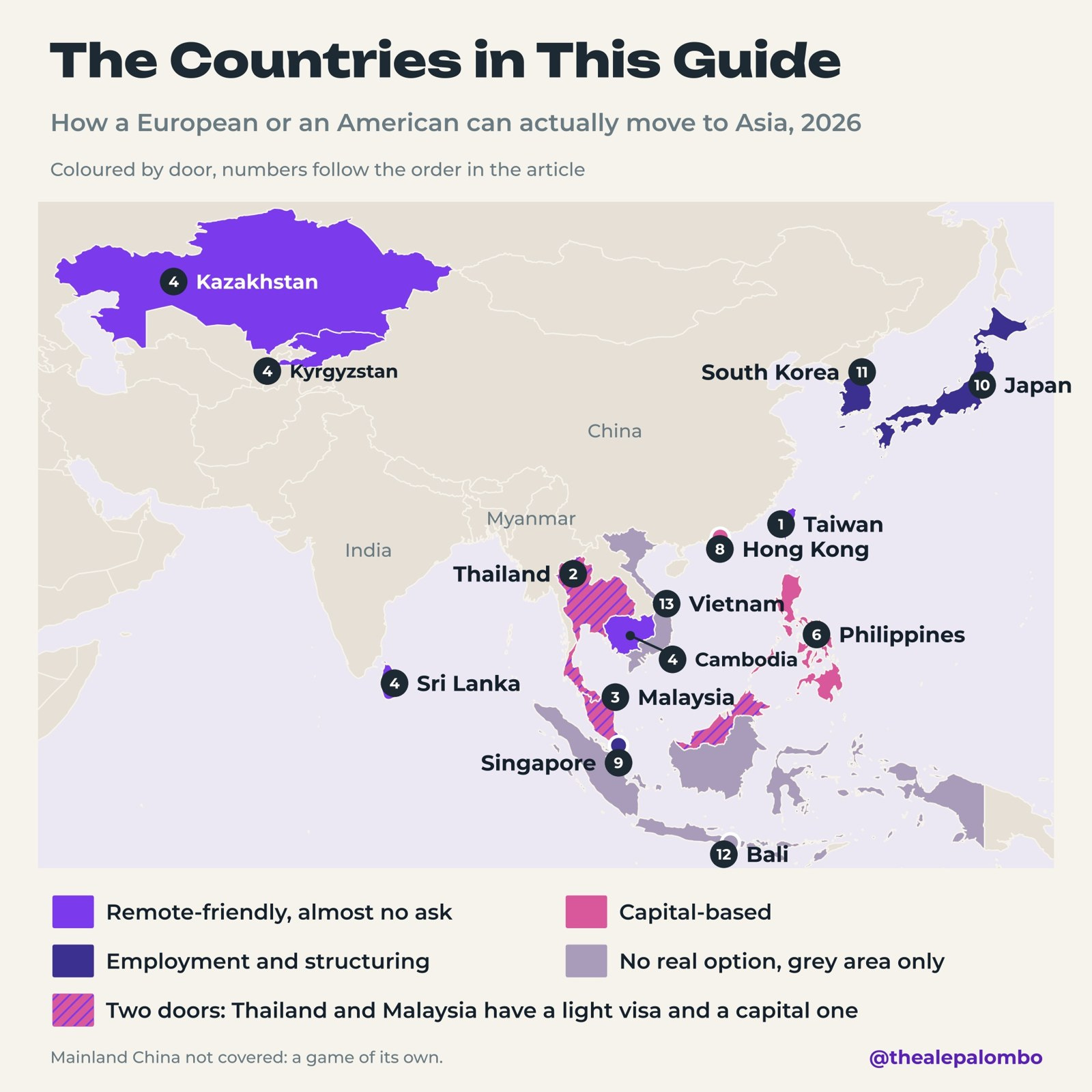
So here’s the map.
The “permanent guest”
Before the countries, one thing that frames the whole discussion: why Asia keeps you on temporary visas. Here Latin America and Asia sit at opposite ends of the spectrum. In my experience the people who choose one would rarely choose the other.
Time zones aside, the two run on a different philosophy. In Latin America residence turns into citizenship in a handful of years: it’s a path to stability. Europe works the same way, slower: ten years in Italy or Portugal and you can end up with a passport. Time converts into belonging.
Asia runs on the opposite idea. In Japan, Taiwan and Korea, becoming a citizen as an adult means renouncing what you are: dual citizenship mostly stays off the table. Thailand’s permanent residency is out of reach for most. From 2027, even Japan’s “permanent” residency becomes revocable.
Why? In my view it comes down to how these countries see themselves. In Japan, Korea, Taiwan and China citizenship passes by blood, from parents to children, and the nation is the people, with a very long shared history behind it. Latin America was built by immigrants, like the US, and almost anyone born there is a citizen. In much of Southeast Asia there’s also the colonial past: after centuries of foreign rule, land and passports are protected on purpose, which is why foreigners can’t own land outright in Indonesia or the Philippines. And Singapore runs on foreign talent on renewable passes, while citizenship stays for very few.

So what is Asia offering? An excellent, renewable, permanent-guest arrangement. You live in a more transient regime, and the sooner you accept it, the better every decision below gets. In all frankness, it happens to you culturally as well: you’ll always be a most respected guest, and never quite “one of them”.
That said, if the idea of being a great guest charms you, this is my list.
The different types of doors
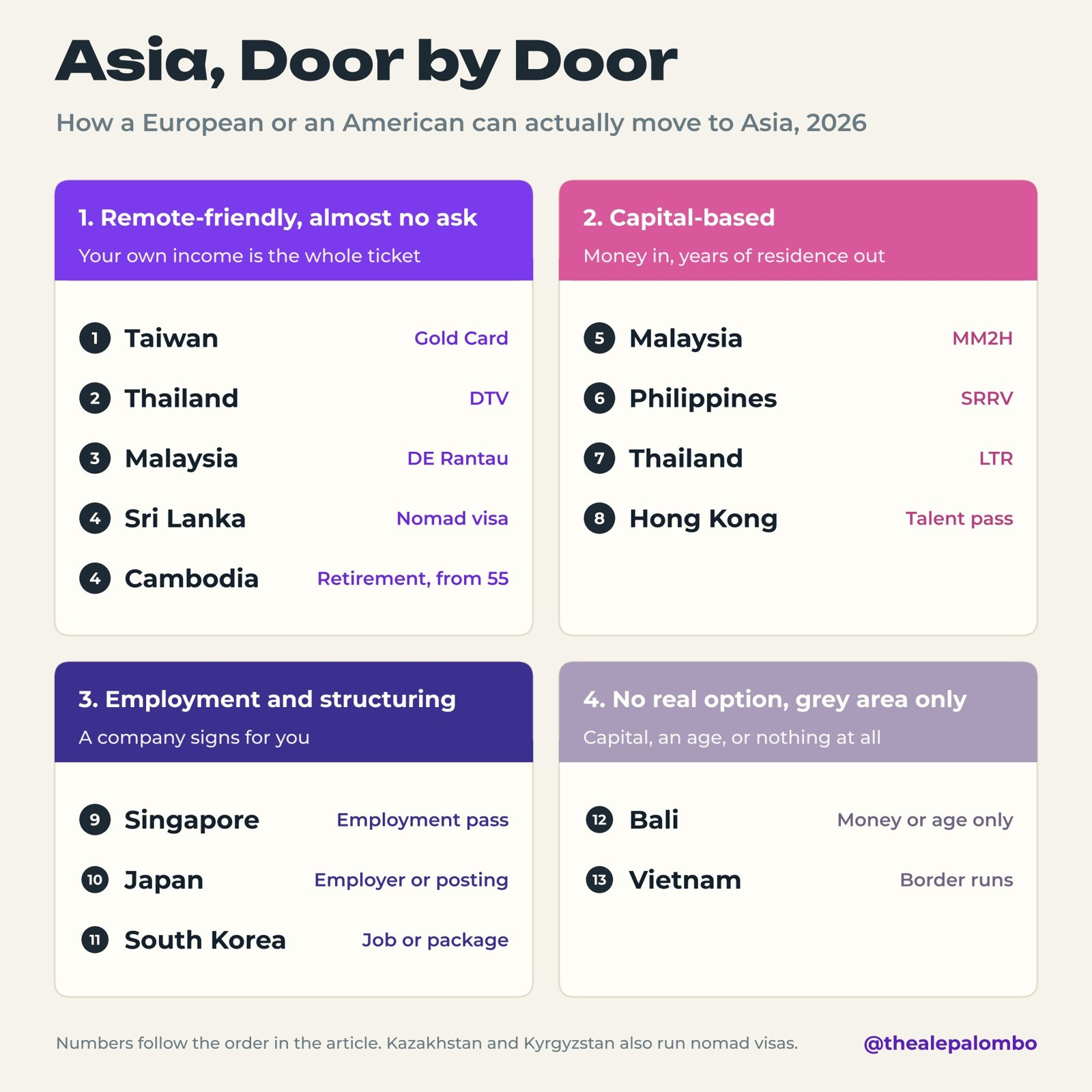
First, how you get in. Overall there are four kinds of doors:
1. Remote-friendly, almost no ask. The country judges you on your own profile, what you earn from abroad, a remote salary, your own clients, and the visa is yours. No employer, no big capital to lock in. You arrive already independent. The rarest and most precious kind, because it asks the least.
2. Capital-based. A transparent transaction: you park a deposit in a local bank or prove a high income, and the country hands you years of residence in return. If you have the capital, it’s the most predictable door of all.
3. Employment and structuring. A local company sponsors you, and the job is the visa: it decides whether you enter, what you can do, and how long you stay. Lose the job and the clock starts. In some countries you can open your own local company and have it hire you.
4. No real option, grey area only. Places where, for the typical person who dreams of them, the doors above are missing: you can visit, even for months, and a real way to stay asks for capital, an age, or was never built at all. The most dangerous kind, because they’re the most beautiful. Many end up overstaying, which of course means breaking the rules.
And the four doors on one slide, just for convenience.
Let’s go.
Category 1: Remote-friendly, almost no ask
They judge you on your own income: a salary history, remote work, some savings. Documents about yourself, and that’s the whole ticket.
1. Taiwan 🇹🇼

Best for: remote workers who want the legal footing, the self-employed and founders.
Taipei might be the most overlooked city in the entire expat conversation, and a recent post of mine confirmed exactly that.
The Gold Card does it all. You qualify on your own salary, around $5,500 a month in recent years, and you apply online. One card gives you residence plus an open work permit for up to three years. No employer, no sponsor, no deposit, and you work for whoever you want, including yourself. After three years of actually living there it converts into permanent residency. A real one. In Asia that’s almost exotic.
There’s a lighter option too, a nomad visa at around $40,000 a year of income. It runs six months, extendable up to two years. Good for testing Taipei first.
Then it compounds. National health insurance after six months, under $30 a month, one of the best systems in the world. And tax-wise there’s a de facto exemption on foreign income up to roughly $240,000 a year, with nuances.
Taiwan is, in all fairness, one of those places where everyone I hear from who lived there has excellent, excellent feedback.
The honest part: local salaries are low, apartments are older and sometimes less well kept than the price suggests, and for Americans there’s still no US tax treaty, which bites the self-employed. The geopolitics is real. Among people actually living there, it’s almost never why anyone leaves.
Top of the list, with an important geopolitical caveat always worth remembering.
2. Thailand 🇹🇭
Best for: remote workers who want the life, and anyone trying Asia for the first time.
The easiest door in Asia, and the most used. We all have that friend in Thailand on a DTV visa.
The famous DTV: a few hundred dollars in fees for five years of multiple entries. Each stay runs up to six months, extendable. The conditions are almost embarrassing. Show roughly $15,000 in the bank, and remote work qualifies you, even a Thai activity like Muay Thai classes does. Since the end of August they also want a clean criminal record and an application from your home country. The free-for-all phase is ending. And since mid-September visa-free entry is down to a month, half what it was, so the DTV went from nice-to-have to the default.
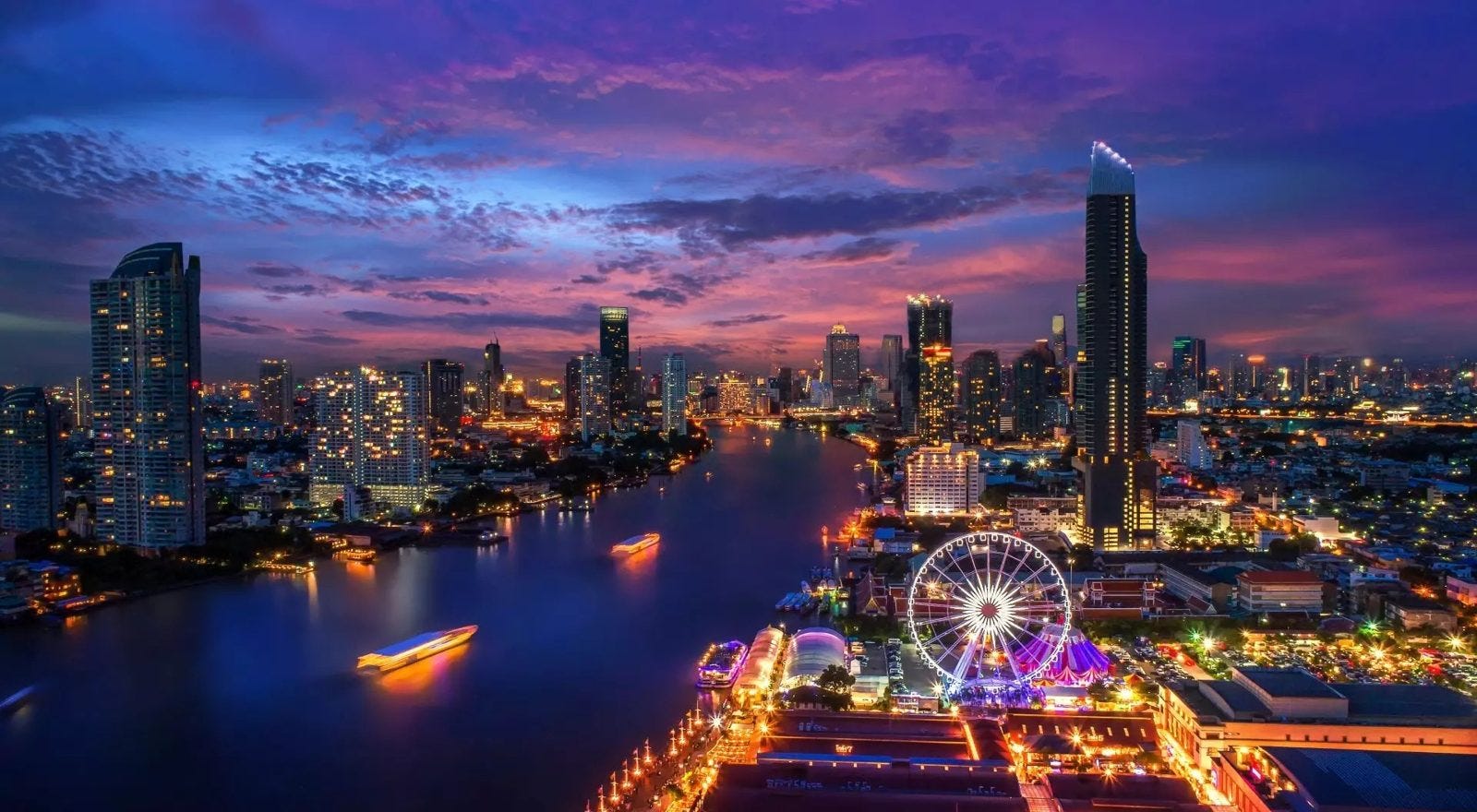
What you get for it is the best plug-and-play life in Asia. You land in Bangkok and in two days you have a SIM, a condo with a pool, a gym and a place for noodles. At $500 of rent it works. At $1,500 you really get everything.
All of this, technically, on a remittance-based tax system: foreign income stays out of scope as long as you keep it abroad.
Now the flaws. The DTV is not a long-stay tool, full stop. There’s no permanent track behind it, and the tax situation for long stayers is a grey area, I covered it in my Thailand thread recently. The serious version of Thailand is the LTR, and it lives in the capital-based group below.
But for trying Asia at all, this is where you start. Regular readers know my line: in your twenties it’s either San Francisco or New York, or Thailand.
3. Malaysia 🇲🇾

Best for: remote workers with their income already sorted, and families on a budget in Penang.
Another overlooked one, and the most comfortable to live in. Even though, after the Network School was shut down there, I asked myself a few questions.
The DE Rantau nomad pass wants around $2,000 a month of income from digital professionals, for a year, renewable once. Modest on paper, and it opens the lowest-friction country in Asia. Former British colony, so English is how the country runs. The exact opposite of my Italy.
Kuala Lumpur gives you real towers, real restaurants and the whole of Asia two hours away, at costs that make Singapore look like a joke. Penang, one hour north by plane: George Town’s shophouses, a beachfront apartment around $1,000 a month, and one of Asia’s medical tourism capitals. People fly in for the hospitals you’d live ten minutes from.
And the tax is the quiet weapon: Malaysia keeps residents’ foreign income out of scope, in writing, to the end of 2036. I double checked.
Two limits. The pass tops out at two years for now, with two more promised in October’s budget, and salaries are local, so arrive with your income already sorted. The long version of Malaysia costs real money, and it’s two sections down.
4. Some “newer options” worth keeping on your radar 🇱🇰 🇰🇭 🇰🇿 🇰🇬
Best for: the adventurous, and retirees whose only enemy is paperwork.
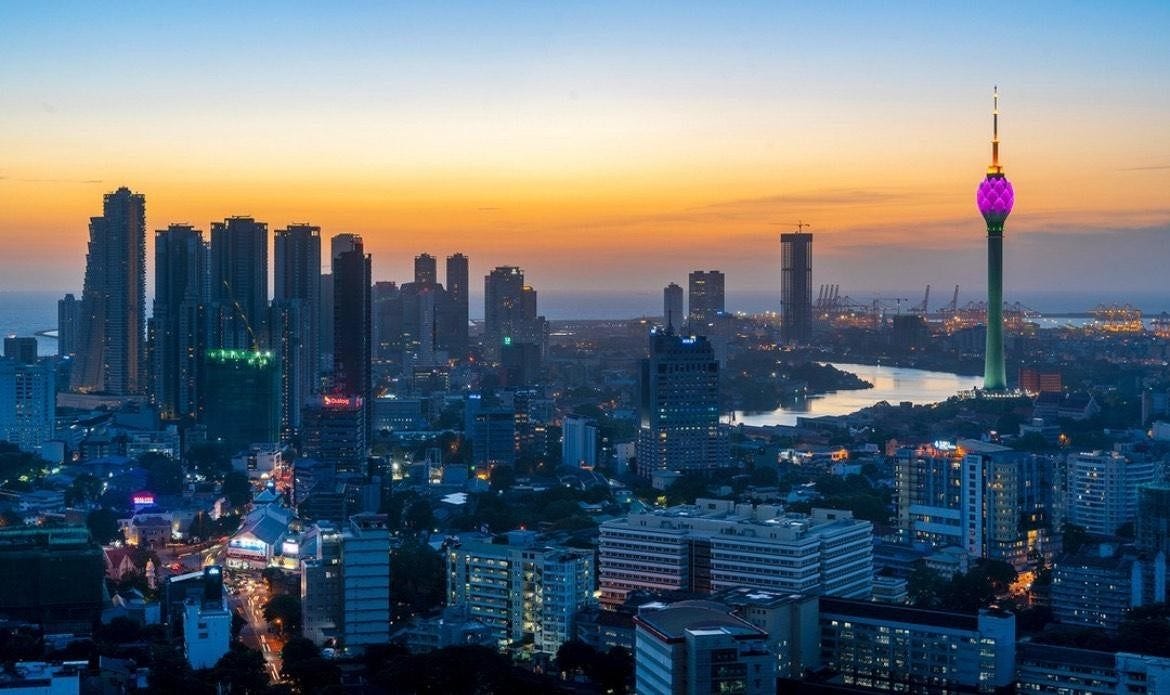
Sri Lanka opened a real nomad door in February: about $2,000 a month remitted into the country, for a year. I’ve met various people from Sri Lanka, some working inside the government’s startup environment, and the direction is clear. It points at Galle and the south coast, some of the most beautiful living on the continent at a fraction of the attention. One caution on tax: the old exemption on foreign earnings ended last year, and remitted income can now face up to fifteen percent. Early rules for an early visa, verify before you build on them.
Cambodia deserves the line nobody gives it: from 55, a retirement extension renews year after year for a few hundred dollars, no deposit at all. Some of the lightest paperwork in Asia, in a country that asks patience for everything else. Cambodia is probably an emerging place that interests many. Let me know if you’re interested: I actually have a friend there right now I can ask.
And for the adventurous, Central Asia joined the game: Kazakhstan runs a nomad visa at $3,000 a month of income, Kyrgyzstan grants nomad status with little more than a registration. Of course, this region only opened up recently, as shown by the fact that Balaji’s Network School announced its new campus there after leaving Malaysia.
I think we’ll hear about Kazakhstan more and more often.
That closes the remote-friendly group. Notice one thing though: Taiwan converts into something permanent, the others stay temporary by design. Even the friendly group is transient.
Quick pause… If guides like this are useful to you, the paid tier is where the in-depth ones live: full guides, the webinar replay library, a private community chat, AMAs, and a vote on what I cover next. The founding rate is $19 a month, locked in for life for the first 300 subscribers. After that, it goes to $29.