


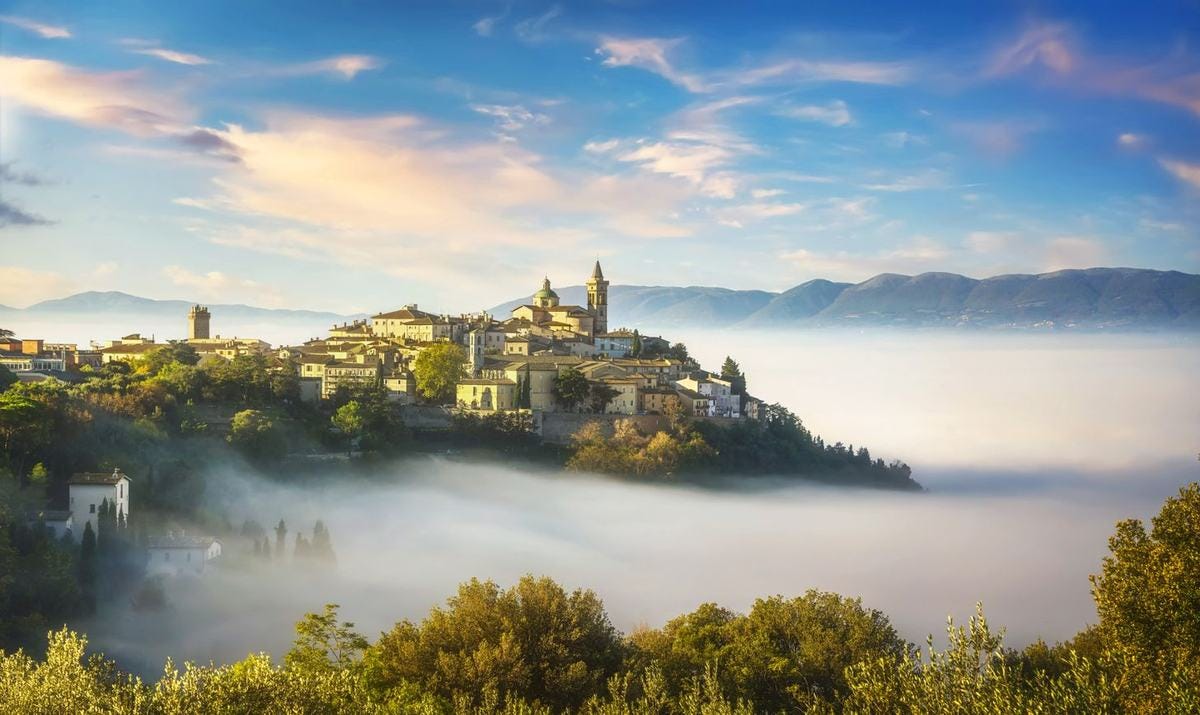
Tuscany is great. Umbria is great as well, at half the price.
Let’s be honest: who, after considering Tuscany, hasn’t spent at least a passing thought on Umbria too?
This is how I imagine Umbria.
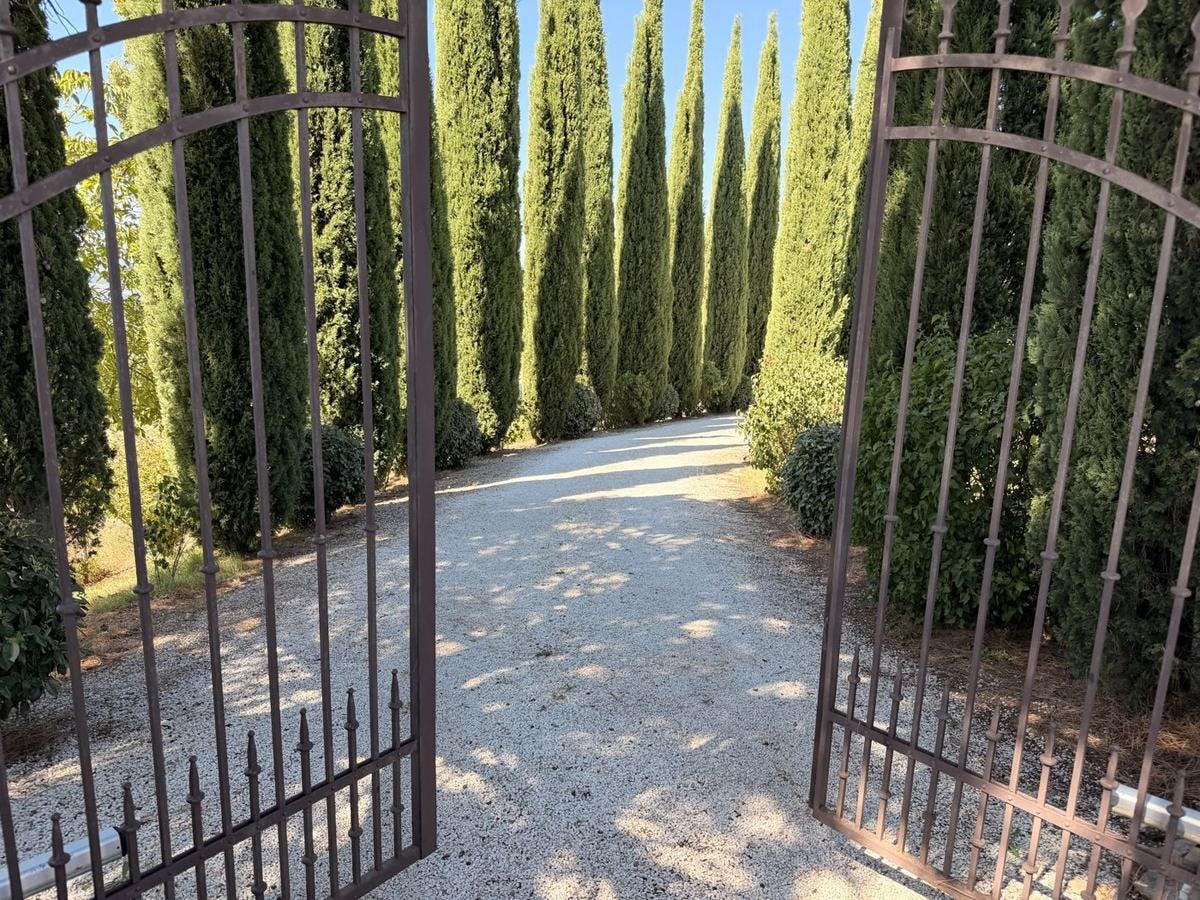
You’re in Rome, finishing your favourite coffee, maybe in Piazza del Popolo. You walk to the garage, take the car, and an hour and a half later you’re in Umbria. You turn into the cypress-lined road that leads to your house: peace, quiet, the smell of fresh cut grass. And yet you’re close to Rome, with services, in a nice area.
This is exactly what I did recently. Not by chance, I had rented a villa in Tuscany right on the Umbrian border. A couple of weeks ago, driving up from Rome, I stopped near Todi to see a house first, as I wanted to see things firsthand and talk to locals. I was particularly interested in the difference between Tuscany and Umbria, and I wanted to refresh my view on it.
I came back with one question: is it worth buying in Umbria? And if so, where?
This is the full version, with all eleven places, prices per town, and a case study with real numbers on buying a ruin versus a finished house.
Before you start…

I’m an Italian qualified lawyer, with a series of companies in this sector. I should be upfront that I have skin in the game here, even if indirectly. I run Bitizenship, which works on Italian and Portuguese residency, and there’s a section at the end about the Italian investor visa that breaks down what we do. In the future we may also launch products close to what I write about here.
Everything below is on-field research and my own reflection, written while I was in Italy, before flying back.
Why this research? Many of the investors we work with are looking at Tuscany and Umbria. And quite often I consider a second house here myself.
So I decided to open up my own notes, together with my wife. Between us we have wide experience in real estate development, and we wanted to understand if it could make sense here, for us or for a future product.
The listings and references I quote are ones I found on the portals. Prices move and portals don’t always agree with each other, so treat every figure as directional and check it again before you take any action. In the end, what you actually pay depends on the time you put into searching and negotiating.
And, as always, nothing here is legal, tax or investment advice for your situation. Before you sign anything, put it in front of a notary and a commercialista. The guide exists so that when you do, you already know what to ask them.
How to use this guide
This is a buyer’s guide, written by an Italian who went there, saw the houses and talked to agents and locals. It’s not a tourist guide.
Three ways to read it:
If you have five minutes, read The short answer and So, would I buy in Umbria? You get my verdict and the places I’d pick.
If you’re seriously looking, read The thesis, decide which city you need close (Rome, Florence or Perugia), then read only the places on that side.
If you’re tempted by a ruin to restore, read the case study before anything else. It may change your budget.
Every place follows the same layout. Best for tells you who it suits, so if that’s not you, skip it. The practical line gives you the distances that matter: water, hospital, station, airport. Then my take, the numbers, and the catch. Each place closes with a card with the key distances and a map, coloured by the side of Umbria it belongs to.
All the prices are collected in one place in Prices at a glance.
Table of contents:
The short answer
Half of Tuscany: a marketing problem
The trend: who is buying right now
The thesis: three Umbrias
The eleven places
Prices at a glance
A note on getting there
Ruin or finished? A brief case study
What it costs to own
My rules if you buy in Umbria
So, would I buy in Umbria?
If you are not European
Final thoughts
The short answer
Yes, Umbria is worth it, but only for a certain kind of buyer: someone who will use the house for ten years or more, doesn’t need the sea, and is looking for a more natural, rustic, authentic life.
And one idea runs through the whole guide: choose the city first, then the town.
All of this is easier to understand once we look at the market.
Half of Tuscany: a marketing problem
This part surprised me a bit. Umbria isn’t a new discovery. Foreigners found it in the early 2000s, prices peaked around 2012, then came a long slide and the 2016 earthquake. Todi is still at around half its 2013 price. This matches my own experience, and to be fair my own memories too.
But in the last two years something changed. Sales were up by more than a tenth in 2024, and again in 2025, the second fastest growth of any region in Italy. Asking prices are moving again: Todi and Orvieto are both up a few points in a year. Spoleto is the exception, slightly down.
And it’s still cheap: a square metre here costs less than half what it does in Tuscany. The regional average is around €1,200.
Why so cheap for so long? If I have to be honest, my very personal take is aesthetics and marketing.
Tuscany has had decades of iconic postcards putting a picture in your head, helped by a big tourist city like Florence and by the sea close by. Umbria never got that.
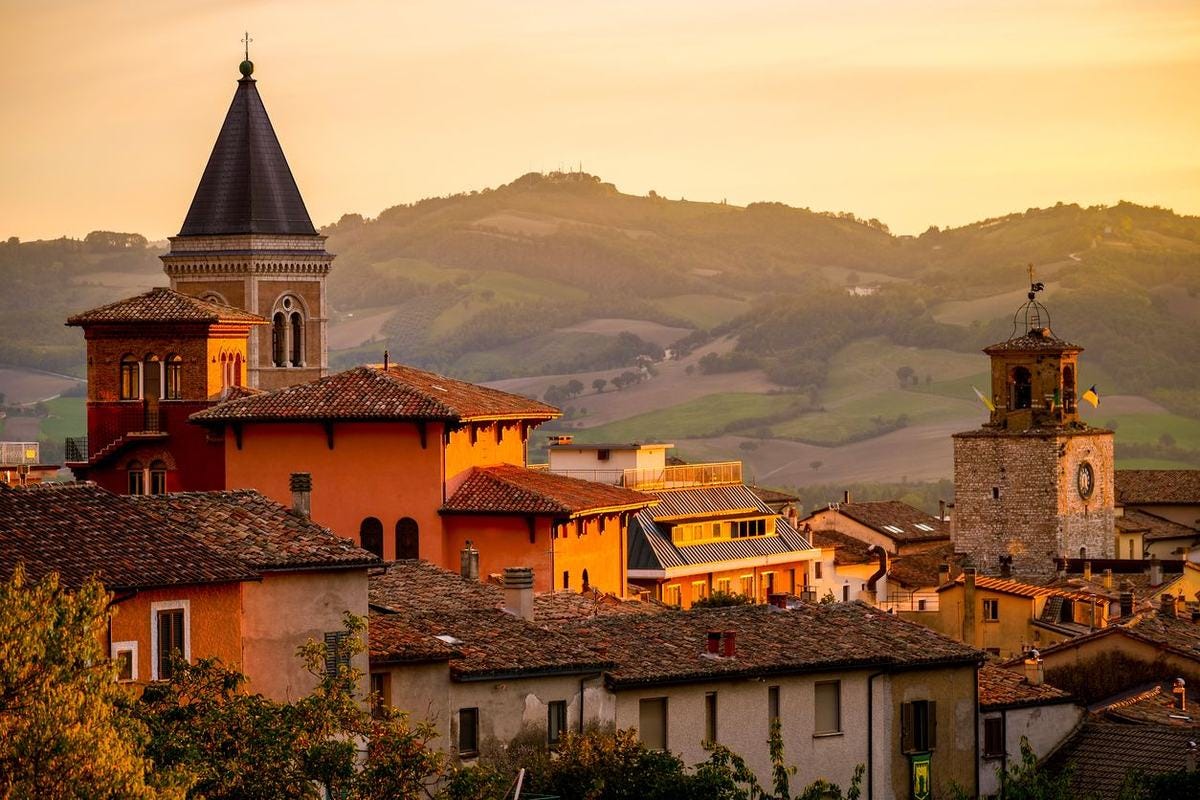
I put real effort into finding the right photos for this piece, and for many places they still don’t do it justice. On camera these towns look less attractive than Tuscany. In person it’s another story: they feel more authentic and, I would say, less staged.
Think about it this way. If friends were spending a few days near Rome or Florence for the first time, what would you be more excited to arrange: Florence, the Val d’Orcia, Montepulciano, or Todi?
That’s also why the house I visited near Todi was on the market at €1.2M: five bedrooms, pool, jacuzzi, indoor sauna, all in very good condition. In Tuscany the same house would cost about double.
The trend: who is buying in Umbria right now, and what the market wants
This matters, because it tells you who you’ll sell to one day, and it helps put things in perspective.
Americans, mostly. One in four foreign enquiries for a house in Italy now comes from the US, and for Umbria American enquiries have more than tripled in five years (Canadian ones even more). These numbers match well with the conversation I had with the real estate agent.
When I explained what I was doing and who I work with, he became extremely interested and gave me a lot of insight, specifically on what American buyers want. It was clear he deals with them practically every single day.
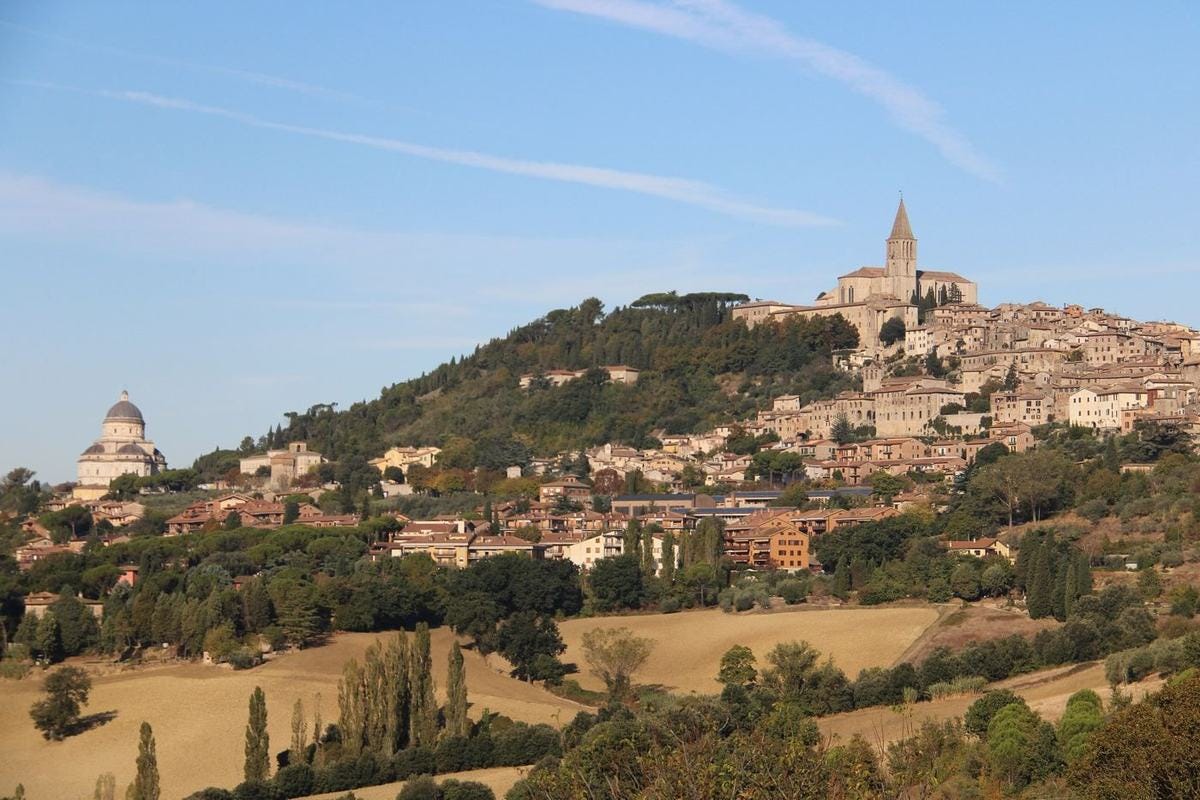
What are the most sought-after places? Todi first, by far. Then Castiglione del Lago and the Trasimeno, Spoleto, Marsciano, Orvieto. The Trasimeno has just entered the top five destinations in all of Italy for foreign buyers, with requests up by almost a third in a year.
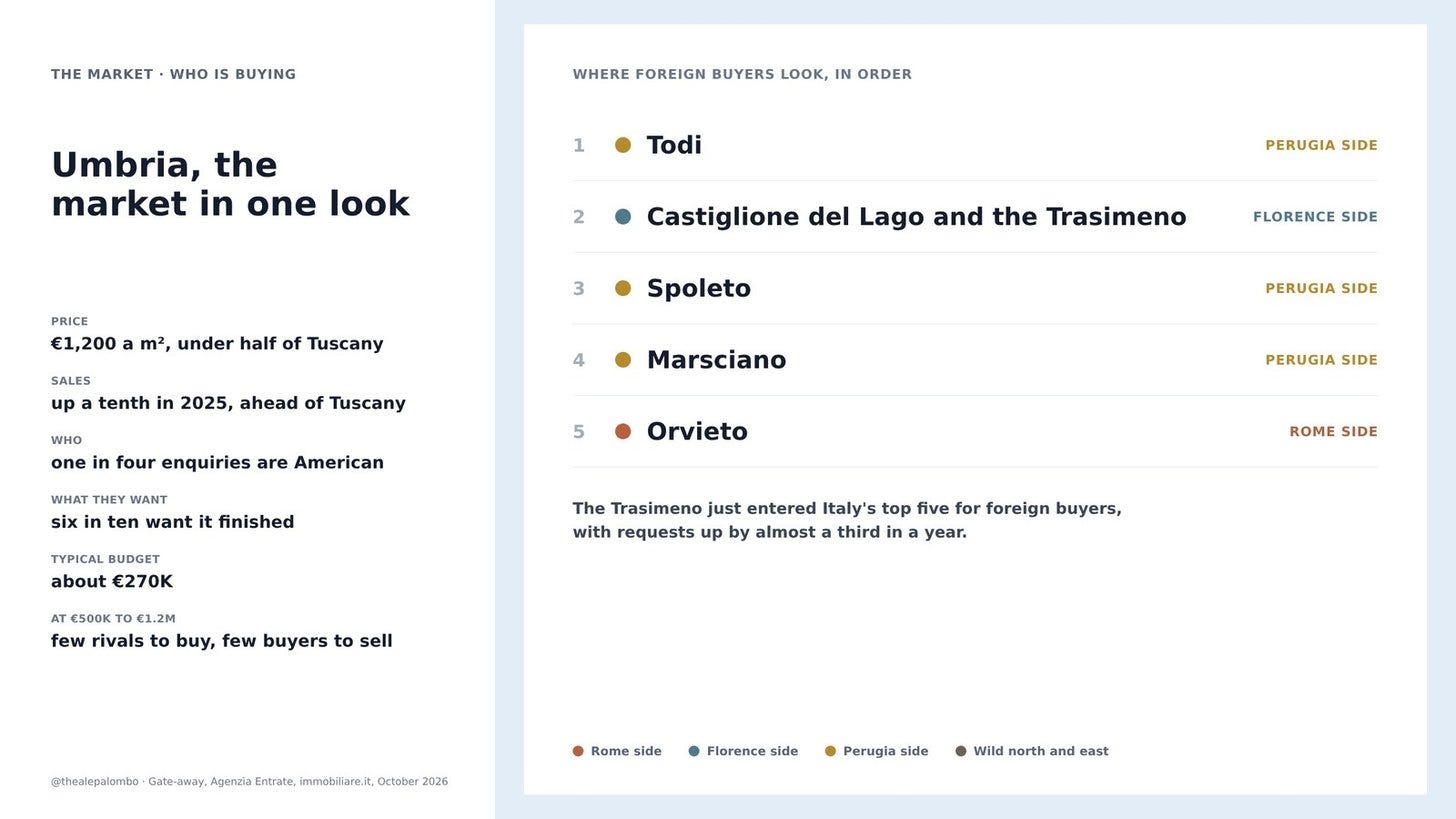
Another number I found interesting: six out of ten foreign buyers want a finished house, ready to live in. And this, once again, was confirmed by the agent. In short, this is the whole game. Renovated or to restore are two different prices and two different universes.
One more detail worth knowing: the average foreign buyer in Umbria searches with a budget of around €270K. So if you’re looking between €500K and €1.2M, you have less competition when you buy, and a smaller pool of buyers when you sell.
The thesis: three Umbrias
Umbria is one region on the map, but when you look for a house it’s really three areas plus two wild corners, and what decides it is the city you gravitate around. Locals have always lived it this way.
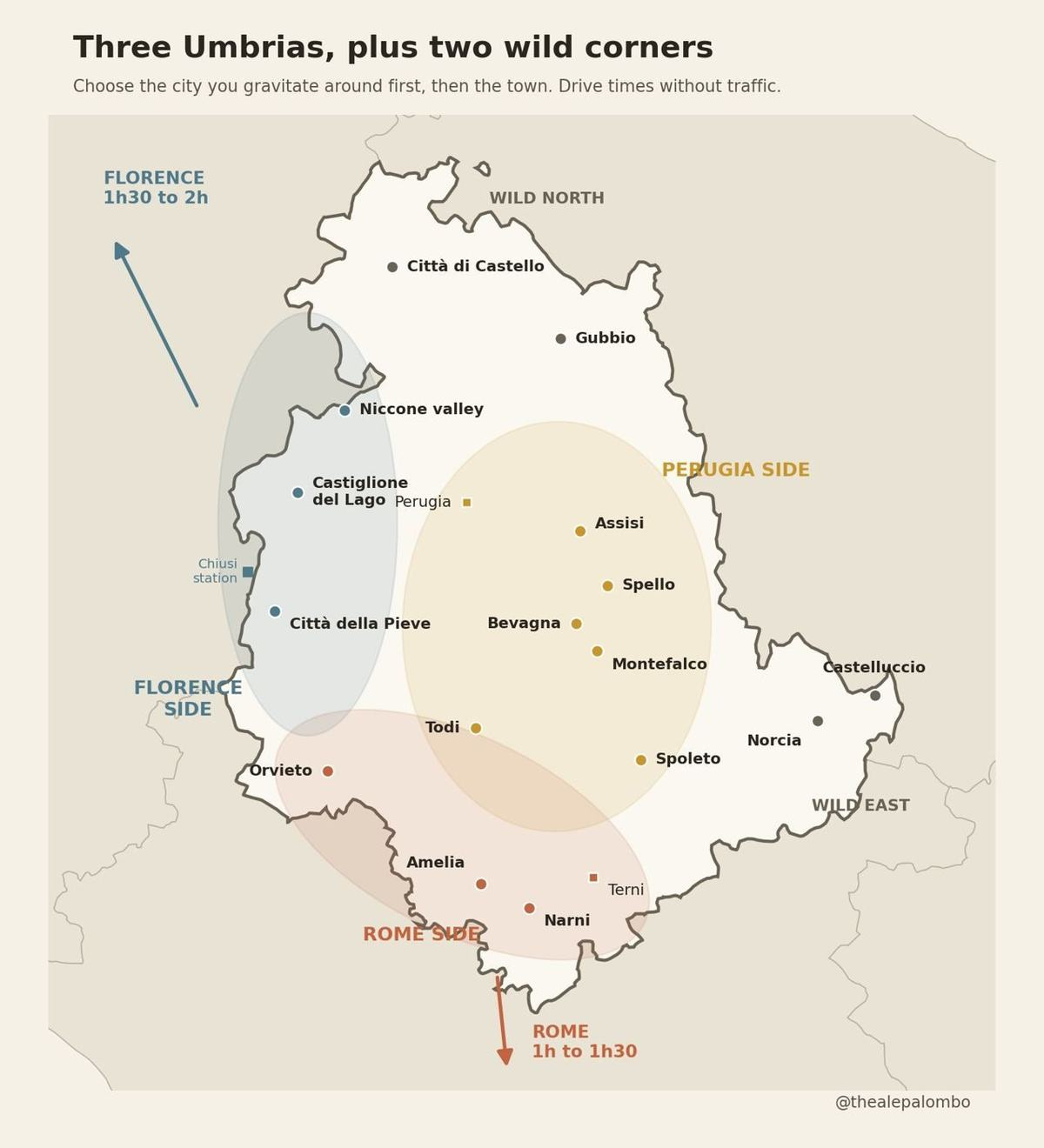
The south, Rome side: Orvieto, Narni, Amelia, Terni. It always looked to Rome (the Via Flaminia, centuries of Papal State), and the dialect to my Roman ear sounds almost like home. One hour to an hour and a half from Rome, by train too. The cheapest part of the region, Orvieto aside.
The west, Florence side: Lake Trasimeno, Città della Pieve and the border towns. People take the train in Chiusi and do their shopping in Cortona. Florence is under two hours away. It’s the most international corner, and here foreigners set the prices.
The middle, Perugia side: Todi, Assisi, Spello, Montefalco, Spoleto. The Umbria you’ve seen in pictures, with a small airport close by and prices in between.
Then the north, Gubbio and the upper Tiber valley, green, quiet and far from everything. And the east, Norcia and the Valnerina: mountains, truffles, and still rebuilding after 2016.
Which one you pick decides a lot, even the vibe and the life you’re going to have. So, as I said, choose the city first, then the town. Below, eleven places with my personal take on each.