


Everyone has an opinion on Estonia's e-Residency. Almost everyone is wrong about what it actually is.
That alone would be enough to write about this corner of Europe. It's one of the largest examples of successful innovation policy we have.
At the same time, together with Latvia and Lithuania, the region can be an interesting place for many families in different phases of life. And it has, for sure, the best summers.
A friend's sister did her Erasmus there and came back an enthusiast, and people ask me about the Baltics more often than you would guess. Founders who want a clean EU company. Families tired of the heat and the prices in the south. And many who simply want to know if the "most digital country in the world" story is real.
So in this letter: the three capitals and where exactly to live in each, what life costs, the summer play, how the company model works and where it becomes a trap, the taxes and visas, the parts few people talk about, and how the Baltics compare with the places you're probably also considering.
One thing before we start, as always. Start from the life: where you want to wake up, the light, the people, the schools, the airport. The tax comes at the end. And here, as you'll see, the tax is the least exciting part of the story.
Let's get into it.
How to use this overview
If you only want the short answer, read The thesis and then My framing at the end.
If you're choosing a city, go straight to the three capitals. Each one has the same layout: who it's best for, the places to consider, the practical line, and the catch.
If you're a founder, the company and tax sections are the core of this letter. And if you want the exact figures, they're all in one place, in the "Prices at a glance" box.
The thesis
Before you start
The scoreboard
The state that runs like an app
Tallinn, Estonia
Riga, Latvia
Vilnius, Lithuania
Prices at a glance
The Baltic summer
The circuit
The company model, and what e-Residency is not
The taxes if you actually move
Who can move, and who belongs
Four counterintuitive points about the Baltics
The downsides
The honest pushback
The Baltics vs the alternatives
If you are not European…
Who is this for
My framing, and final thoughts
The thesis

The Baltics are Europe's function play.
Smaller, colder, better run. The state works from your phone, people speak English, a company opens in a day, and the rules don't change every time a minister wakes up in a bad mood. The price is less light in winter, a smaller scale, and less going on.
The way I frame it, they're the exact mirror of Thailand, which I wrote about in Thailandmaxing. Thailand gives you the perfect life on a fragile structure. The Baltics give you a perfect structure, and a life you have to want: Nordic weather, and that kind of environment.
And let me tell you my real motive. I'm not looking at the Baltics as the next place to move. I got curious because if a corner of Europe runs this well, I want to understand why, what we can learn from it, and where Europe is going. And for company setups, it may hold some interesting surprises.
Before you start
Most people picture something grey, cold, ex-Soviet. What you actually find is three EU countries with the euro, Schengen and NATO, where the bureaucracy that eats your life in Italy or France mostly happens on your phone.
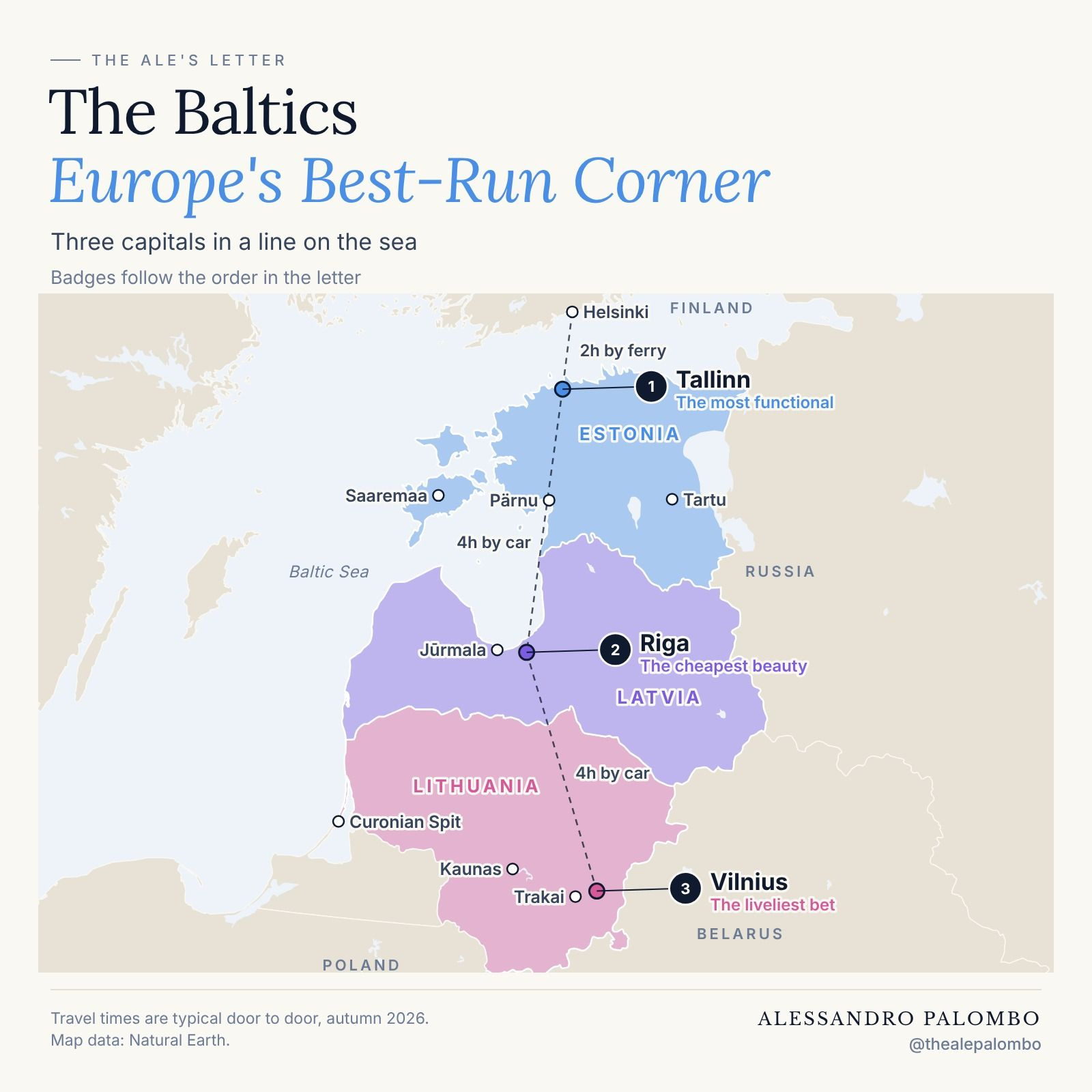
They sit in a line on the sea. Tallinn in the north, two hours by ferry from Helsinki. Riga in the middle. Vilnius in the south, inland, and now the biggest of the three.
The first thing to understand is that the Baltics are three very different countries. Three languages, and Estonian isn't even related to the other two: it's a cousin of Finnish. Three temperaments too. Estonia looks north, to Finland and the Nordics. Latvia is the crossroads, with the most mixed society of the three. Lithuania looks south-west, to Poland and Central Europe, with which it shares centuries of history.
A few disclaimers, as always. There is a reason something costs less, and here the reason has a name: winter. These are small societies, quieter and more reserved than what most of my readers are used to. And this is a high-level overview, not a manual for people already there, whom I actually invite to add their own experience in the comments.
The scoreboard
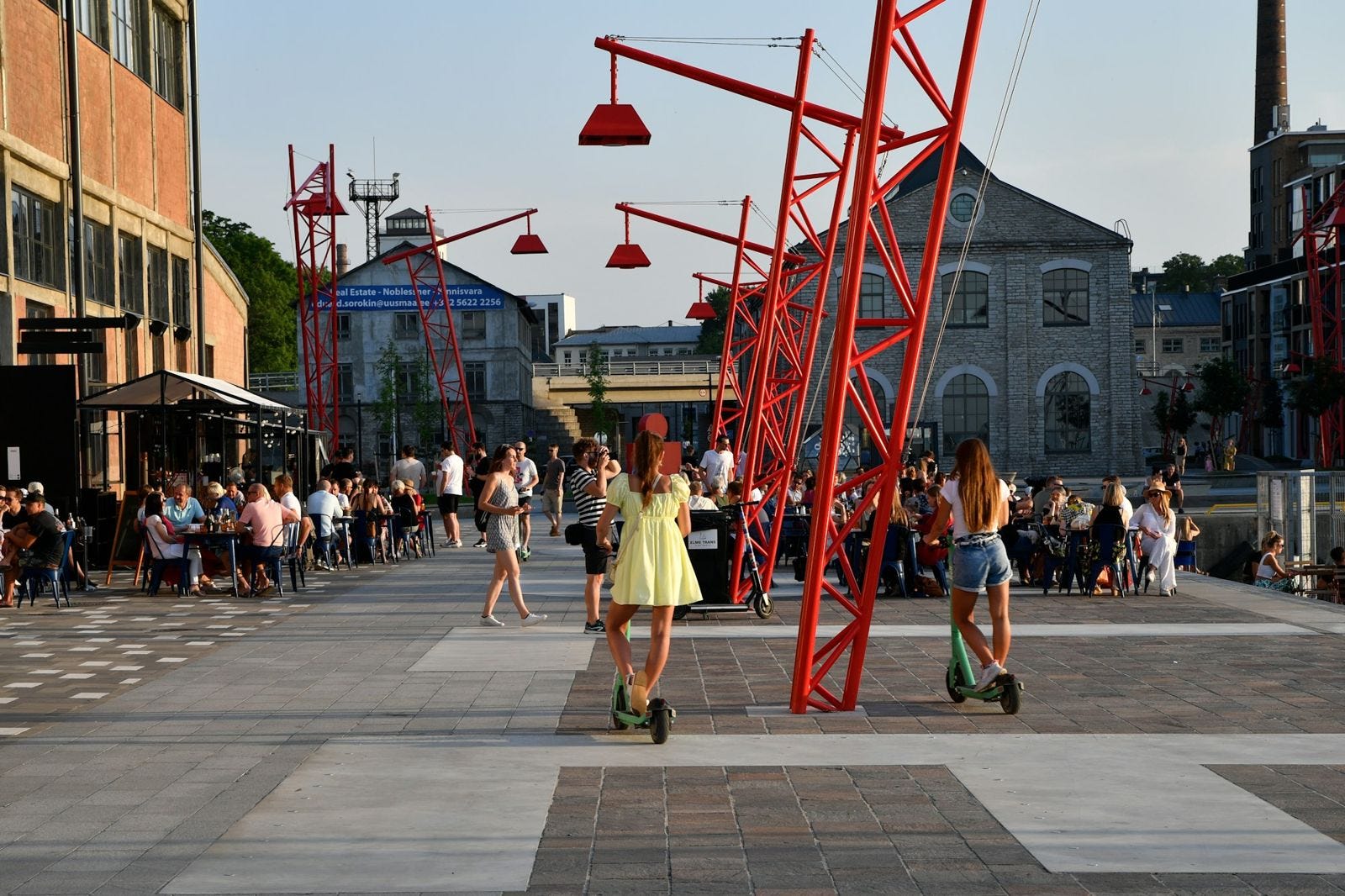
First, is the model actually working? This is what convinced me to write this letter.
Convergence, the big one. In the mid nineties the Baltics were far behind the EU's average living standard. Today Lithuania is closing in on the EU average, Estonia isn't far behind, and Latvia, the slowest of the three, has been one of the fastest climbers in the whole Union over the last decade. Nothing else in Europe converged like this.
Foreigners as an economic engine. In Estonia, one in five new companies is now started by an e-resident, a foreigner who often has never set foot in the country. Last year those companies paid the state a record amount in taxes, more than twelve euros for every euro the programme costs to run. In Vilnius, foreigners went from a rounding error to more than one in ten residents.
And now the other side. Estonia tipped into slight net emigration in 2025, the first time in more than a decade. And only a small fraction of e-resident companies pay real tax. In other words, the model attracts companies more easily than people, and we'll come back to this.
The state that runs like an app
Let me explain what "digital state" means in practice, because the phrase is used so much it has lost its meaning.
In Estonia, your ID card is also your digital signature. You sign a contract, a lease or a company resolution from your laptop, and it has the same legal value as ink. You file your taxes in a few minutes, because the form is already filled in and you just check it. Prescriptions are digital. Your health records follow you. Almost every public service is online, and the state has a rule I'd love to see in my Italy: it may never ask you twice for information it already has.
Underneath all this there is a data exchange layer called X-Road, running since 2001, that lets every database talk to every other without one giant central file. This was long before AI in government was even a thing.
And the ingredient that makes people accept it is trust with verification: every citizen can see, log by log, which official looked at their data, and ask why. This alone fascinates me.
Latvia and Lithuania are less famous for it, but closer than most people think. Both sign and file digitally, and Vilnius in particular has built a regulator the fintech world openly praises.
I've had structures in about ten countries, from Delaware to Singapore, and this is the rarest thing, and the first I'd look at when incorporating a company: admin that simply works. Taxes matter, but they're never the only thing to look at.
Let's now look at the actual lifestyle.
Here is where things get interesting, and why many people, especially nomads and people working in tech, look at this region: at least on price, it could be an alternative to Southeast Asia. And as you know, there's a lot to say about that.