
Stack Your Passports Like You Stack Bitcoin
Why the smartest people I know are building sovereignty portfolios

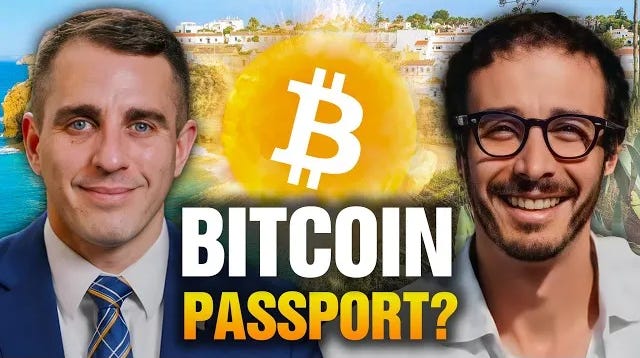
Last week, I sat down with Anthony Pompliano in New York.
Side note: people talk poorly of NYC but I found the energy to be electric. Though paying $15 for a sandwich and $160 for an Uber in the rain certainly adds a certain intensity…
We discussed many topics but especially something that's been building for years:
The complete convergence of Bitcoin and sovereignty.
Not as theory. Not as philosophy.
As something you can actually do. Today.
These days I’m based in Lisbon, where we've built a solution with Bitizenship that previously didn't exist:
A way to gain EU citizenship while maintaining Bitcoin exposure.
The response has been overwhelming.
Successful entrepreneurs, Bitcoin OGs, names you'd recognize – all quietly positioning themselves for what's coming.
The opportunity isn't about running away from any system.
It's about running toward optionality in an increasingly uncertain world.
For those building wealth in the digital age, the insights from our conversation deserve a fuller exploration.
Here are some key takeaways and expanded thoughts on what we discussed:
The Core Thesis: Diversification Beyond Assets
Much of our conversation centered on a simple concept:
Stack your passports like you stack Bitcoin.
Both represent insurance against single points of failure. Both require long-term thinking. Both seem unnecessary until they become essential.
Concentration risk doesn't just apply to portfolios. The same logic holds for citizenship.
A single passport ties you to one country's:
Tax system
Political decisions
Economic policies
Travel restrictions
Future unknowns
Multiple passports create what I call a sovereignty portfolio – optionality that compound over time.
Much like Bitcoin.
The Surprising Volatility of Citizenship Programs
During our conversation, I shared a comparison that surprises most people:
Golden visa and citizenship programs are more volatile than Bitcoin.
This is not hyperbole. Consider what's happened recently:
🇪🇸 Spain: Ended Golden Visa program in April 2025.
🇲🇹 Malta: Their citizenship by investment program was terminated by the European Court of Justice in April 2025. One court ruling, and a program that had operated for years vanished overnight.
🇵🇹 Portugal: Eliminated real estate investment options after property prices increased 8x in 9 years. Extending the citizenship timeline from 5 to 10 yrs.
The pattern is clear and accelerating.
Unlike Bitcoin, where volatility creates buying opportunities, when citizenship programs close, they're gone permanently.
Portugal's Unique Position (And Why It Won't Last)
Portugal stands apart from every other European option.
The key differentiator: You don't need to relocate.
Every other EU golden visa program requires significant physical presence. Greece, Italy, Spain – they all expect you to actually move there. Portugal requires just 14 days every two years.
Combined with a five-year path to citizenship (the fastest in Europe), Portugal offers something unique: EU citizenship without lifestyle disruption.
But here's what I shared with Anthony that many don't realize – this won't last.
For example, Portugal will soon extend the citizenship timeline from 5 to 10 years.
The window is open, but narrowing.
The Bureaucratic Moat (And Why It's Actually Good)
Anthony asked about the challenges, and honestly…
It's extremely frustrating.
Coming from tech and startups, dealing with government systems feels like running a marathon when you're used to sprinting. The complexity exists at every level – not just the laws, but what I call "the layer below the general law” – the details of how the rules should be applied.
But that complexity is the moat. If it were easy, everyone would do it.
The difficulty creates the opportunity.
Countries offering these programs may not be the most efficient countries yet – and that inefficiency is precisely why they need to attract capital and talent through these programs.
We position ourselves as an intermediate layer between the huge complexities and sometimes the nonsense generated by legacy systems and the needs and desires of modern investors.
My Background and Journey to This Space
My path here wasn't typical. Anthony asked about my journey to this space and I realised I haven’t shared much about my story that frequently.
At 25 years and 3 months, I became arguably the youngest qualified lawyer in Italy. Could have taken the traditional route – big firm, safe progression, predictable life.
Instead, I got a PhD in administrative law, then spent a decade building startups in the sovereignty field. Advised governments on blockchain regulation. Last year, generated over 240 million organic impressions on X discussing these topics – something that surprised even me.
This background matters because citizenship programs exist at the intersection of law, policy, and technology. Understanding how governments think – their concerns, objectives, and constraints – is essential for navigating this space.
As I told Anthony, dealing with government bureaucracy can be frustrating. But that complexity is also why the opportunity exists.
To bridge these worlds seamlessly.
How We're Solving the Bitcoin Investor's Dilemma
The problem was always finding investment opportunities aligned with Bitcoin principles. Real estate felt wrong. Generic funds missed the point.
So we created the first fund investing in Portuguese companies within the Bitcoin ecosystem.
We wanted to help the local Bitcoin ecosystem grow while solving the investment challenge.
The structure we built:
The structure:
€500,000 minimum investment
Qualifies for Portuguese golden visa
Provides exposure to Bitcoin-aligned companies
7-year fund duration
1.5% annual management fee
10% performance fee
This all began as a solution for our friends in the Bitcoin community. My wife had previously run golden visa funds before the real estate option was eliminated.
We understood both the bureaucratic requirements and what Bitcoiners actually wanted.
The NEW Italy Innovation
I shared an exciting new development:
Our upcoming program for Italy’s Golden Visa + Bitcoin.
Starting next month, we're launching something that's never existed – a golden visa program that accepts Bitcoin directly.
Key differences from Portugal:
€250,000 investment (half of Portugal's requirement)
Direct Bitcoin investment accepted
Returns paid in Bitcoin
Requires actual residence (6+ months annually)
10-year path to citizenship
For those holding appreciated Bitcoin, this eliminates the taxable conversion event that typically occurs. You can invest Bitcoin and receive Bitcoin back.
The residency requirement is real – you must genuinely live in Italy.
But at half the capital requirement of Portugal, with direct Bitcoin acceptance, it opens new possibilities.
The Portugal Golden Visa through our Bitcoin ecosystem fund remains the most efficient path to EU citizenship for Bitcoin investors.
With programs closing across Europe, the current terms represent an increasingly rare opportunity.
Portugal is extending the citizenship timeline from 5 to 10 yrs.
But if you invest before the new law gets approved you will be granted the current terms.
For those interested in learning more about Bitizenship and these programs, reply directly to discuss your situation.
The Donation Option and Tax Efficiency
We also discussed an alternative path that surprises many:
Donation-based citizenship.
We're launching a €200,000 donation option for Portugal that accepts Bitcoin.
Yes, donation means no capital return. But for specific situations, it could make sense.
If you're sitting on Bitcoin with significant unrealized gains, donating directly can be more tax-efficient than converting to fiat, paying capital gains, then investing. We're the first to offer this at €200,000 instead of the standard €250,000.
Sometimes your best investment isn’t necessarily the one you get back.
Who's Actually Using These Programs?
As I shared with Anthony, we've onboarded successful entrepreneurs – many well-known names, though privacy prevents disclosure.
They're not fleeing anything. Their primary motivation is creating a Plan B. Not because they're paranoid, but because they're prudent. Nobody knows what the world looks like in 20 years, or even 10, or sometimes even 5.
These are business people who understand that concentration risk applies to citizenship just as it does to investments and that European access means exposure to 27 different countries – 27 different systems and options.
They come from everywhere: Americans, British, Indians, Brazilians, Mexicans, Chinese.
The desire for optionality is universal.
The Infrastructure for a Borderless Future
Toward the end of our conversation, we discussed the bigger picture.
Borders were designed for a physical world – no internet, no Bitcoin, no remote work. As someone with a PhD in administrative law who has studied these systems, I see the mismatch between our digital reality and territorial legal frameworks growing unsustainable.
In the next 20-30 years, with AI and digital economies, the ability to operate across jurisdictions won't be luxury. It'll be necessity.
This is why we're building what I call "infrastructure for a borderless future."
Not because borders will disappear, but because smart capital and smart people need options that reflect how the world actually works.
Key Takeaways for Action
If our conversation revealed anything, it's that waiting has real costs.
European constitutional law protects vested rights. Once you enter a program, those terms are locked in. They can change rules for future applicants but can't touch existing investors.
But this protection only applies to those who act, not those who wait.
For those considering their options:
🇵🇹 Portugal: Still offers the best combination – EU citizenship in 5 years without relocation. But the window is narrowing.
🇮🇹 Italy: Launching next month with Bitcoin acceptance at half the investment. Requires residence but opens new possibilities.
Timing: Every year brings fewer options at higher prices. The trend is unmistakable.
Looking Forward
As I told Anthony, we're not just processing paperwork. We're building infrastructure for how citizenship and investment will work in the future.
The convergence of Bitcoin and sovereignty isn't coincidental. Both represent self-determination in a digital age.
Those who understand this convergence and act accordingly will have options others won't.
The choice, as always, is yours.
But unlike Bitcoin, you can't buy citizenship on the dip.
Watch the full conversation with Anthony Pompliano below for additional insights and discussion.
What are your thoughts on building a sovereignty portfolio? I'd love to hear your perspective.
P.S. We will be hosting a webinar with Bitwise CIO Matt Hougan for a live conversation on whether Bitcoin is ready to take the global stage.
Key topics we will cover:
Global de-dollarization: narrative or reality?
Can Bitcoin step up as a reserve asset for a multipolar world?
What would a BTC-denominated future actually look like?
July 31st, Thursday, 5pm Lisbon / 6pm CET / 12pm New York / 9am California
REGISTER HERE and save your seat now!

And if you enjoyed reading this post, feel free to click the ❤️ button and restack so more people can discover it on Substack! 🙏