Crypto Tax Map
170+ Countries, All Tax Rates, One Place

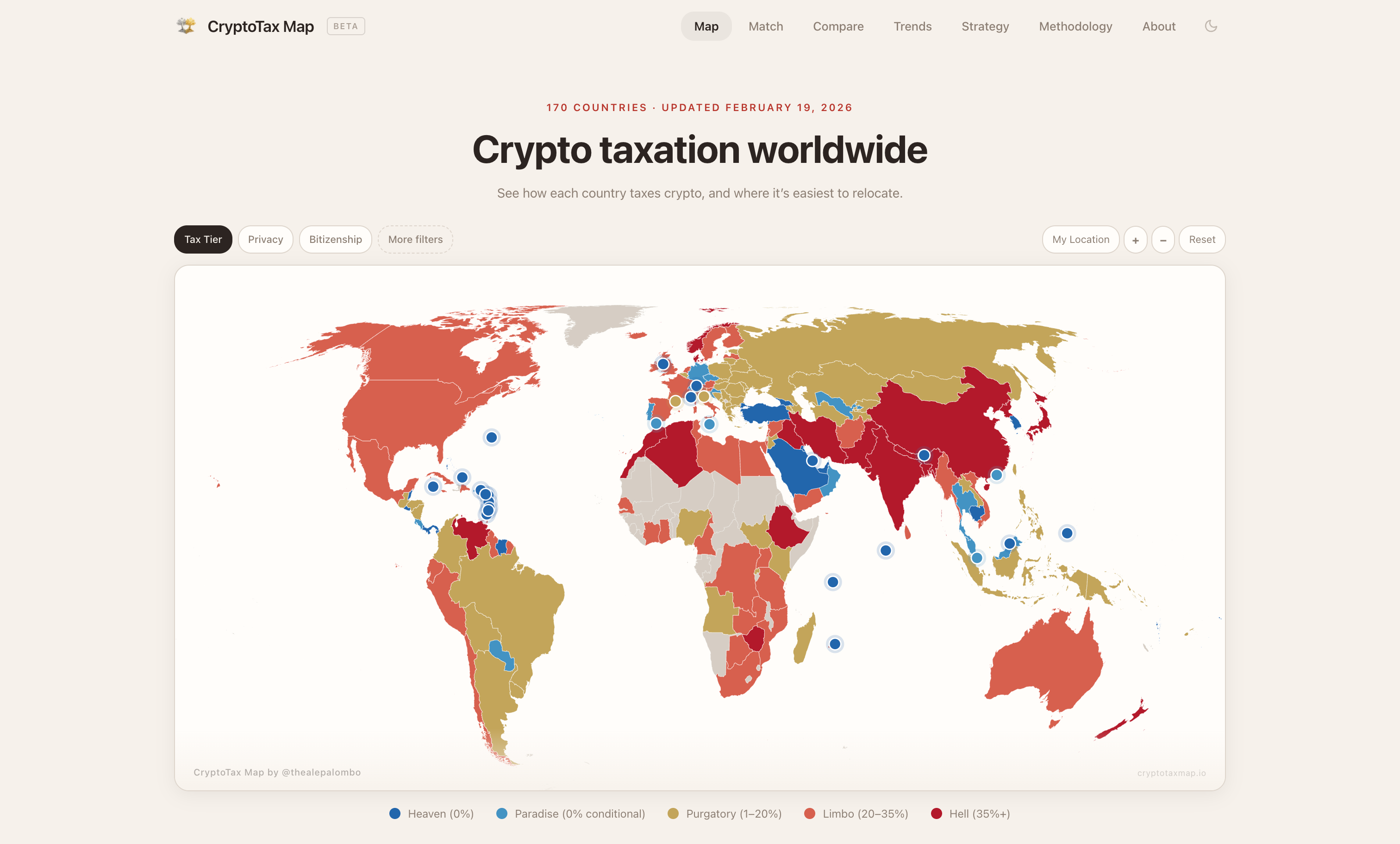
Mapping out all the different tax regimes for crypto is a struggle.
I understand this firsthand.
You’d think after years of building at the intersection of global regulation, digital assets, and citizenship planning – after raising over $25 million in Bitcoin-aligned residency programs, working directly with governments across multiple continents – I’d have this figured out.
I didn’t.
Every time I needed to compare crypto tax treatment across jurisdictions, I was opening 15 browser tabs, government websites, and even Crypto Twitter rumors that may or may not reflect reality. The information existed, but it was scattered, contradictory, and often outdated within months.
And so that’s why I built CryptoTax Map.
Partially as an experiment in what AI tools can actually do when you need comprehensive research at scale. Partially because I was tired of answering the same question twenty different ways: “Which countries have favorable crypto tax treatment?”
The real answer? It depends on what you mean by “favorable.”
What I Found Mapping 170 Countries
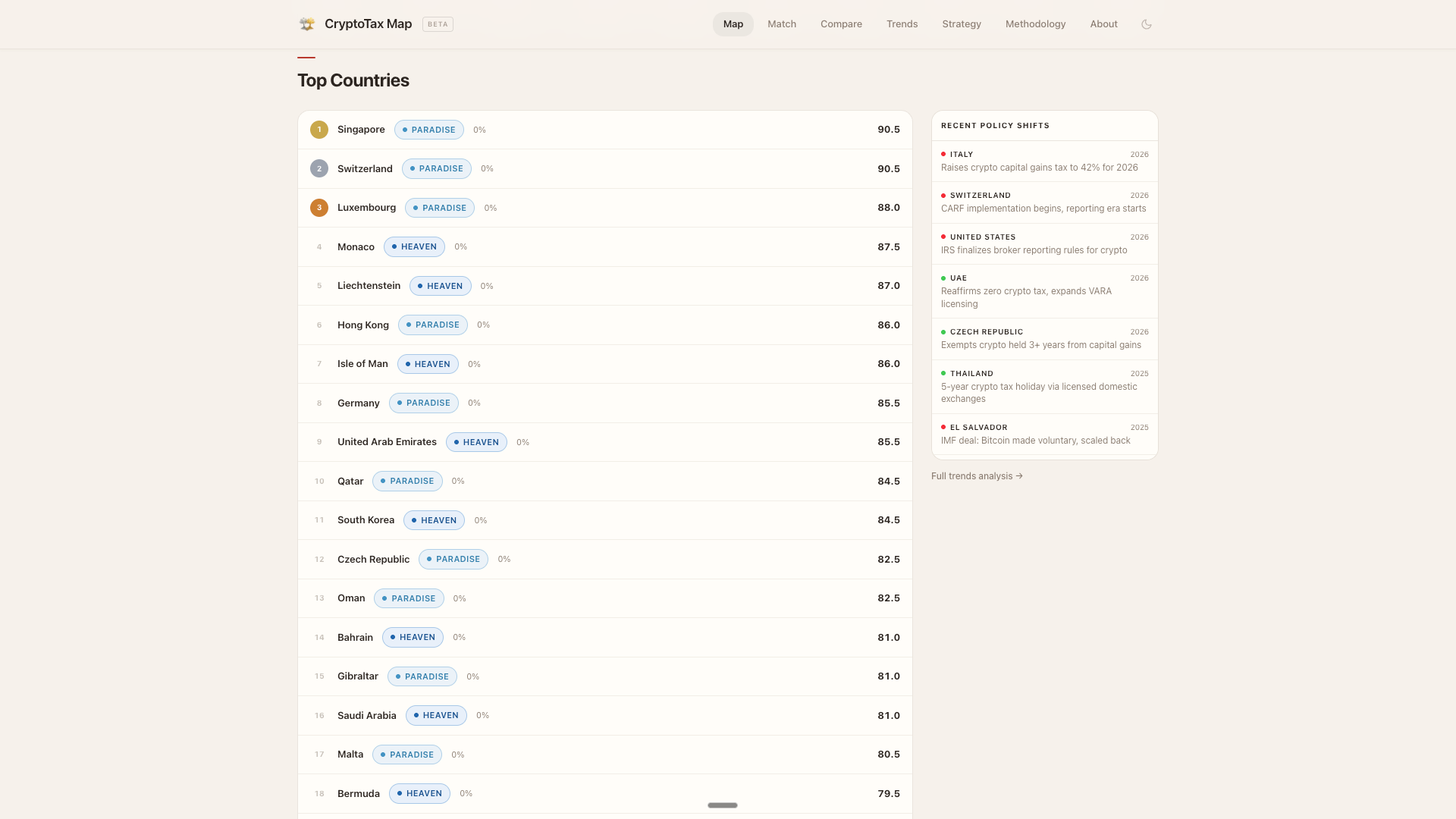
There are 32+ countries with 0% tax on crypto. Most people wouldn’t be able to name three.
When I started building this, I expected the usual suspects to dominate: UAE, Switzerland, Singapore. Tax havens and financial centers. What surprised me was how geographically diverse the 0% list actually is.
Germany has 0% crypto tax. Not on everything – but if you hold for more than a year, your gains are completely tax-free. No cap. You could realize €10 million in Bitcoin gains and pay zero.
South Korea: 0% currently. A 20% capital gains tax has been delayed multiple times and keeps getting pushed back.
Czech Republic, Hong Kong, Qatar, Monaco, Liechtenstein – all 0%. Isle of Man, a jurisdiction most people couldn’t locate on a map, scores higher than the United Arab Emirates on overall crypto-friendliness when you factor in regulatory clarity, banking access, and enforcement predictability.
The pattern that emerged: 0% tax rate and “best jurisdiction” are not the same thing.
Singapore scores 90.5 – the highest overall ranking. Switzerland ties it. Both have 0% crypto tax under specific conditions, but more importantly, both have legal clarity, strong property rights, functional banking systems that won’t freeze your accounts randomly, and governments that won’t change the rules retroactively.
Luxembourg (88.0) outranks Monaco (87.5) despite Monaco having better weather and no income tax at all. Why? Regulatory framework, EU harmonization and actual crypto businesses can operate there without constant legal uncertainty.
This is what the tool had to account for: tax rate is one variable in a 9-dimensional equation.
The Match Engine
Now the main challenge wasn’t collecting tax rates. It was making this information useful.
If you’re earning $80K as a freelance developer, El Salvador’s 0% crypto tax looks attractive. But if you’re moving $5M and need private banking infrastructure, El Salvador doesn’t crack the top 30.
If you value privacy and want minimal reporting requirements, Singapore’s 0% tax comes with FATCA and CRS compliance. Portugal charges 28% on short-term gains but 0% if you hold over a year – different tradeoff entirely.
If you’re American, half the 0% tax countries become irrelevant because the US taxes worldwide income regardless of where you live.
So I built the Match Engine.
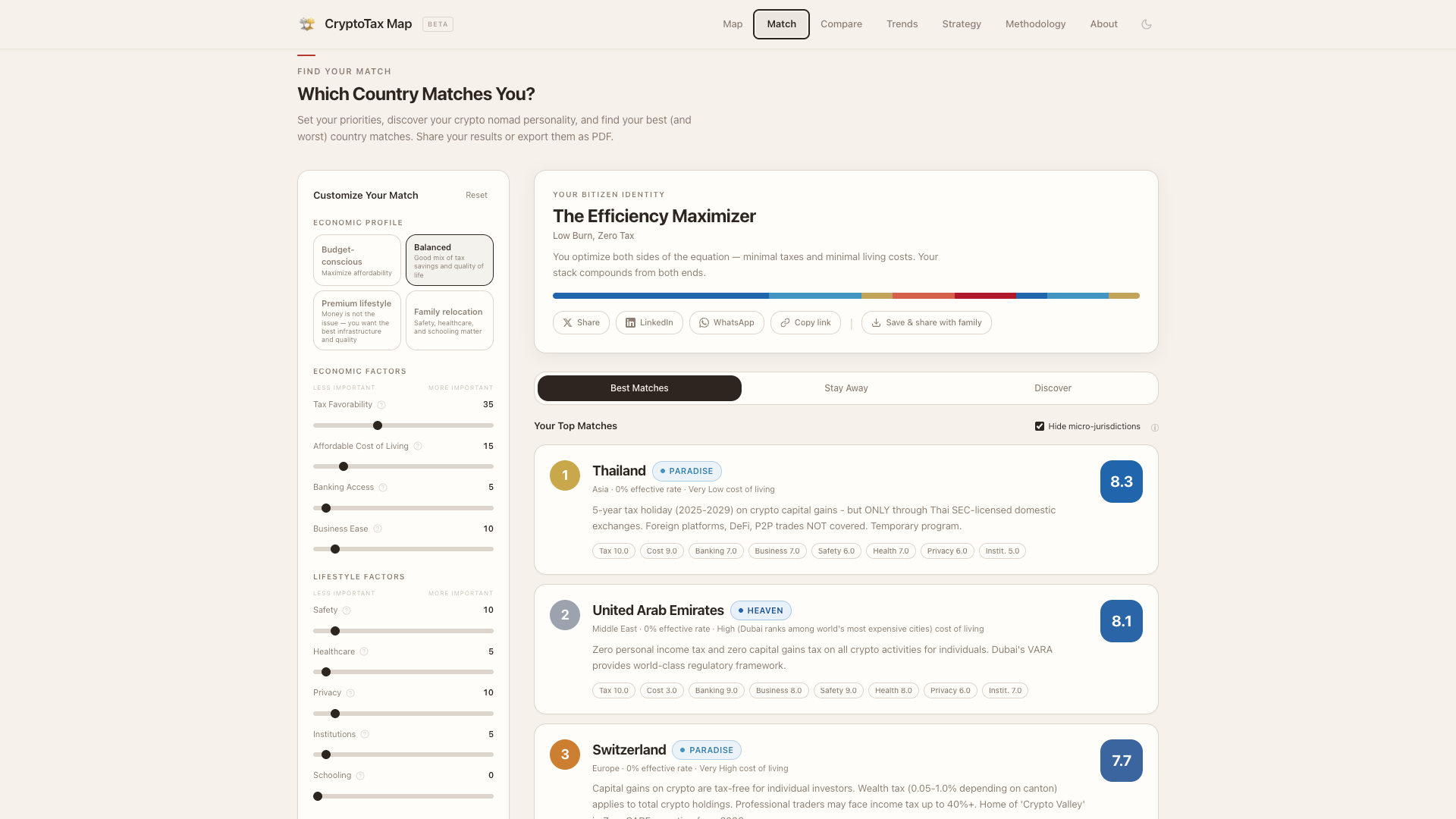
You set your priorities – tax rate, safety, privacy, healthcare quality, cost of living, golden visa availability – and it scores every country against your specific situation. Not some generic “best countries” list but close to your optimal list.
The weighting matters. A lot of people think they want 0% tax but what they actually want is 80%+ wealth retention with legal certainty and the ability to sleep at night.
The Match Engine helps you figure out which trade-offs you’re actually willing to make.
Why This Stays Free
I don’t plan to make this paid. It’s going to remain a free tool.
I’m convinced there is huge value here that other places charge $10,000 to $50,000 for – jurisdictional analysis, tax optimization strategy, relocation planning – that I can deliver with a research-driven approach and make freely accessible.
The tool is supported by Bitizenship, where we build products that maintain Bitcoin exposure while you gain new residencies or citizenships. Indirect exposure through Bitcoin-aligned structures.
I’m building this because I don’t plan to do consultancy. Instead, I want to understand what you as users need and build tools that solve those problems in an infinitely superior manner.
This is the first of what I’m planning as a growing ecosystem of free tools for my community. Next up: transforming my Citizenship and Residencies guide into a platform.
After that, we’ll see what you tell me you need most.
What You Can Do With It
CryptoTax Map has four main tools:
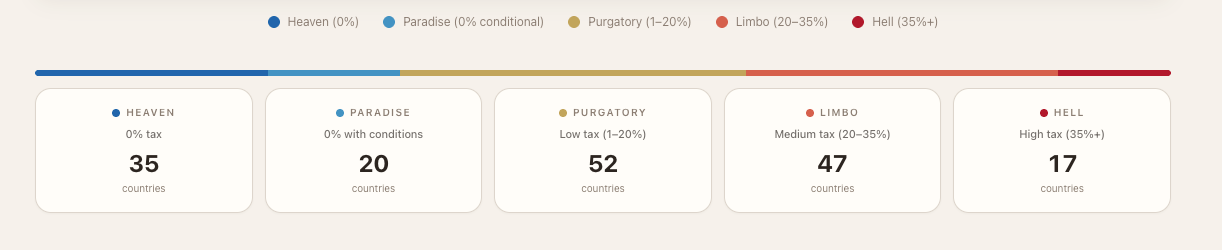
The Map: Visual overview of all 170 countries color-coded by tax tier. See at a glance which jurisdictions have 0%, low, moderate, high, or very high crypto tax.
Compare: Side-by-side comparison of up to 3 countries with radar charts, detailed breakdowns, and verdict scoring across 9 dimensions.
Trends: Crypto-friendliness index tracking 26 key jurisdictions annually from 2020 to 2026. See which countries are moving toward friendliness (UAE, El Salvador, Switzerland) and which are tightening (China, India, Nigeria).
Strategy: The Match engine that scores every country against your priorities, plus a Tinder-style Discover mode if you want to swipe through options.
Filters let you narrow by 0% tax, privacy level, Bitizenship program availability, FATCA compliance, and CARF reporting requirements.
The data updates continuously. Major review cycles align with FATF plenaries in February and October, EU Council updates, and Big Four annual publications. Individual country changes get updated as legislation passes.
This Is a Beta
I really appreciate feedback.
The tool got a big upgrade recently thanks to community suggestions: better color coding, dozens of fixes, the Match engine, the Discover function. But it’s still evolving.
If you find errors, DM me on X (@thealepalombo) or reply to this email/leave a comment. Corrections will get prioritized.
If you want features added, tell me. I’m building this in public specifically to learn what actually matters to people making these decisions.
At the same time, AI is going to revolutionize everything we know about research and information synthesis. This tool is partially an experiment in what’s possible when you combine comprehensive data collection with AI-assisted analysis.
I’m learning as I build.
Not Tax Advice
This needs to be said clearly: CryptoTax Map is an informational tool, not tax advice.
Tax laws are complex. They change frequently. Your specific situation matters. Always consult a qualified tax advisor before making decisions.
What the tool does is give you a starting point. A way to see the landscape. A framework for asking better questions. But it doesn’t replace professional guidance.
What I’m Curious About
My plan beginning with this piece is to introduce more technical deep dives over time. Country-specific breakdowns. Regulatory trend analysis. Strategic frameworks that places charge tens of thousands for.
What would be most useful to you?
Are there specific countries you want detailed profiles on? Features you’d use if they existed? Questions the current tool doesn’t answer?
The goal isn’t to build the tool I think you need. The goal is to build the tool you actually need.
Try CryptoTax Map. Tell me what’s missing.
And if you enjoyed reading this, feel free to click the ❤️ button and restack so more people can discover it on Substack.
Stay free,
Ale
Writing from Lisbon
Thanks for this great work and for sharing it!
Regarding Italy, you say that crypto-crypto exchange is taxable. Are you sure? That is not my understanding.